
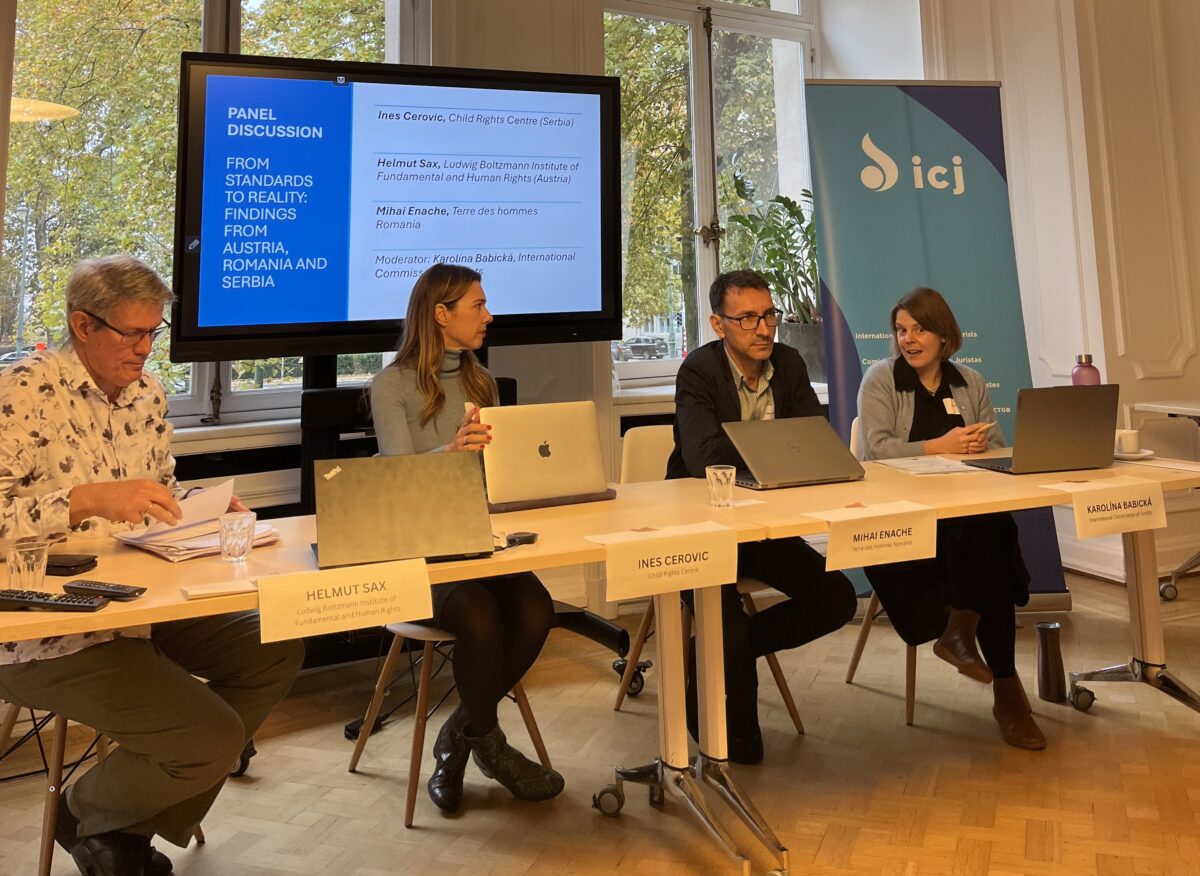
On 3 and 4 November, Validity Foundation took part, within the framework of the ENSURE project, to the conference From Rights to Reality: Ensuring Meaningful Participation of Child Victims with Disabilities in Criminal Proceedings. It gathered a group of justice professionals, policymakers, child protection specialists, psychologists, psychiatrists, disability rights advocates and civil society representatives. This conference opened a dialogue around one question: what can be done to make justice adapted to the needs and circumstances of all children, particularly children with disabilities? Following fruitful discussions, we have identified supports that children victim of crime requires to move through proceedings in a safe, participatory and trauma-informed way.
Within European Union member states, legal provisions that protect the right to access justice and participation on equal basis for children with disabilities can be found at the intersection of several international and European legal instruments. Defining the principles of equality, accessibility, non-discrimination, and the right to participate on an equal basis with others, these instruments require Member States to recognise children with disabilities as persons with legal capacity, to hear them directly and give due weight to their views in line with their age and evolving capacities, and to provide procedural accommodations, age- and gender-appropriate support and trained professionals, so that every child receives support that responds to the needs arising from their life journey. Yet the findings of the Left to Discretion report, show that in Austria, Romania and Serbia practice remains fragmented, and often rely on individual professionals’ will. For instance, individual need assessment procedures are absent, late or incomplete; support professionals are brought too late in the proceedings, or not at all; legal information remains largely inaccessible to all children; parents often replace the child’s own testimony; and a medical approach to disability still makes access to justice based on a medical diagnosis.
The ENSURE project findings demonstrate that justice systems can do better: proceedings can be child-centred, respectful, accessible and tailored to each child’s needs. Drawing on the work of the Model Rules-Based Process, we presented how justice systems must approach individual assessment, provide procedural accommodations, and the different roles that need to surround children throughout the proceedings to protect their rights, dignity and condition.
- The special representative: An independent legal professional appointed by order of the court to represent a child victim and advocate for the legal interests and views during criminal proceedings.
- The intermediary: A professional who facilitates effective communication between a child with communication needs and justice actors. Their duty is to the court. As such, they are neither an advocate for the child nor an interpreter or expert witness.
- The support person: A trusted adult (a professional or someone from the child’s own life) appointed to provide psychosocial and emotional support to a child throughout the legal proceedings.
To understand the practice of intermediaries, C. O’Neill, H. Carroll and K. Collins, professional intermediaries from Intermediaries for Justice, gave an excellent overview of their daily work, including the techniques, materials and approaches intermediaries use with children and young adults in the United Kingdom. To know more about their role among the British justice system, watch A Voice for the Voiceless, a film produced by Intermediaries for Justice UK.
The ENSURE project will continue until the first quarter of 2027, when further events will share the project’s results. Follow us and our partners on social media for more information!