
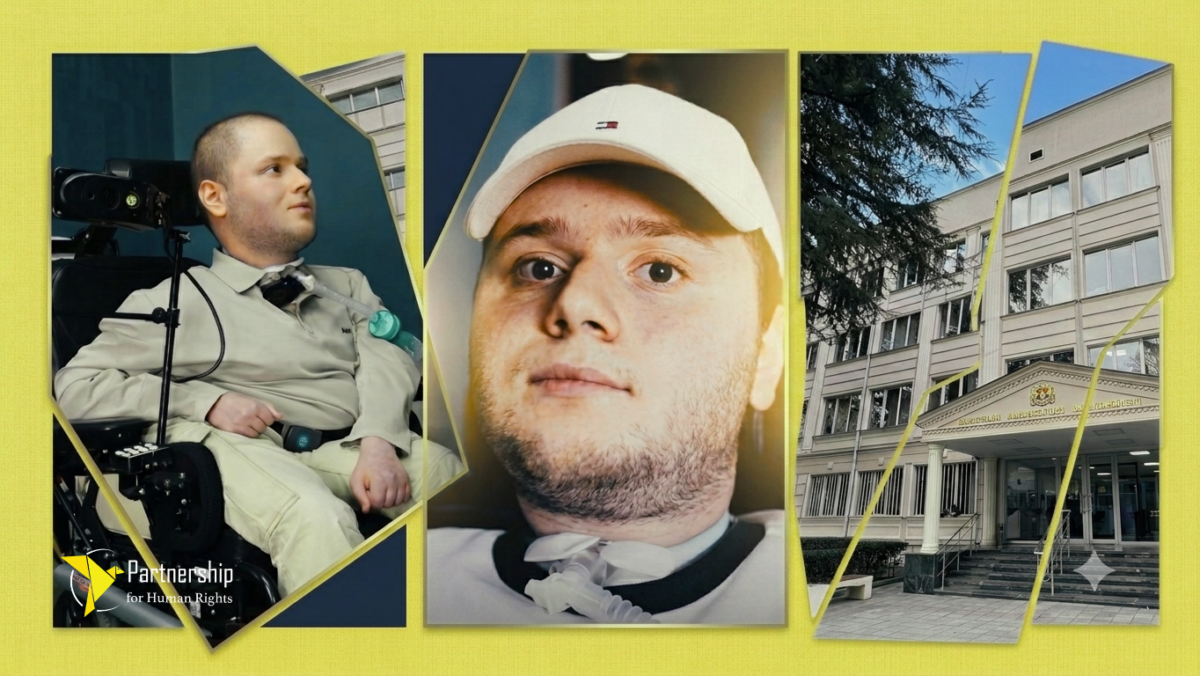
The Tbilisi Court of Appeal has overturned a lower court’s ruling and fully granted an interim measure request from Beka Shonia, a 21-year-old with Duchenne muscular dystrophy (DMD), ordering the extension of home medical services and provision of a new ventilator. Advocates say it is the first ruling of its kind in Georgia to secure home-delivered medical services and a ventilator for a person with a disability, offering a legal path to avoid forced hospitalisation.
Shonia has used mechanical ventilation since 2018 and, due to a lack of accessible housing, has not left his home in more than five years. His mother sold part of the family’s flat to buy his first ventilator; the technician who serviced the machine, now seven years old, warned it was at risk of failing.
The ruling follows a 45-day protest that began in April 2026, when people with DMD and their families held a round-the-clock demonstration outside the Government Administration in Tbilisi demanding life-saving medical services and funding for DMD medications. Authorities refused protesters permission for any temporary structures, including tents, so participants spent 45 days and nights exposed to wind and severe weather, sleeping on plastic bank chairs on the street. Unable to physically join the protest, Shonia recorded and shared videos from his home in support of the demonstration, adding his voice to the call for the government to protect the rights of people with DMD.
The protest ended after the government agreed for the first time to introduce medical services for people with DMD, and to work toward funding access to health care.
DMD Services Introduced, But Still Out of Reach
When the government subsequently amended the State Health Protection Programs, the new services remained inaccessible to Shonia: he could not travel to medical centers to receive them, and no provision was made for home delivery or for replacing his failing ventilator.
With support from the Partnership for Human Rights (PHR) and the Validity Foundation, Shonia applied to the domestic courts for an interim measure extending medical services to his home and providing a new ventilator. On June 4, 2026, the Tbilisi City Court denied the request. Shonia and his advocates continued the legal challenge, and on July 29 the Tbilisi Court of Appeal overturned that decision, granting his request in full.
“I Want Other Duchenne Children and Mothers Not to Go Through What We Went Through”
“I hope the judge heard my voice. I spoke in fragments because the tracheostomy makes it difficult to speak, but I wanted to say what I had to say: I want other Duchenne children and mothers not to go through what we went through. My mother had to sell her house so I could breathe, and I do not want anyone else to have to do the same. This is worth fighting for, and I hope I achieve a result.”
Shonia took part personally in the court hearings, using his limited speech, affected by a tracheostomy, to advocate not only for himself but for all people with DMD and disabilities in Georgia.
“Beka is not merely a single plaintiff; he is the voice of every person with DMD in Georgia whose rights have been denied by a system that isolated them, made them invisible, and stripped them of their rights. A person with a disability, even when locked in an isolated space by a lack of basic accessibility, should still be able to reach the court, as Beka did. The court cannot be another locked door. It must stand as the one gateway that stays open, the passage through which every other right is reached“, said –Anna Arganashvili, representing Shonia during hearings.
Separately, and with advocacy support from PHR and the Validity Foundation, the Tbilisi City Hall is currently carrying out accessibility renovations to Shonia’s residential building.
A Precedent Beyond One Case
Organisations involved in the case describe the July 29 ruling as the first in Georgia to establish access to home-delivered medical services and examinations, along with a ventilator, for a person with a disability, a precedent advocates say should extend to all people with disabilities who currently face forced hospitalisation or institutionalisation, some for years at a time, due to a lack of home-based alternatives.
Shonia and his advocates say the legal fight is not over. He intends to continue pursuing the dismantling of regulations that enable disability-based discrimination in violation of the UN Convention on the Rights of Persons with Disabilities (CRPD) and Georgia’s constitution.